
12. June, 2023
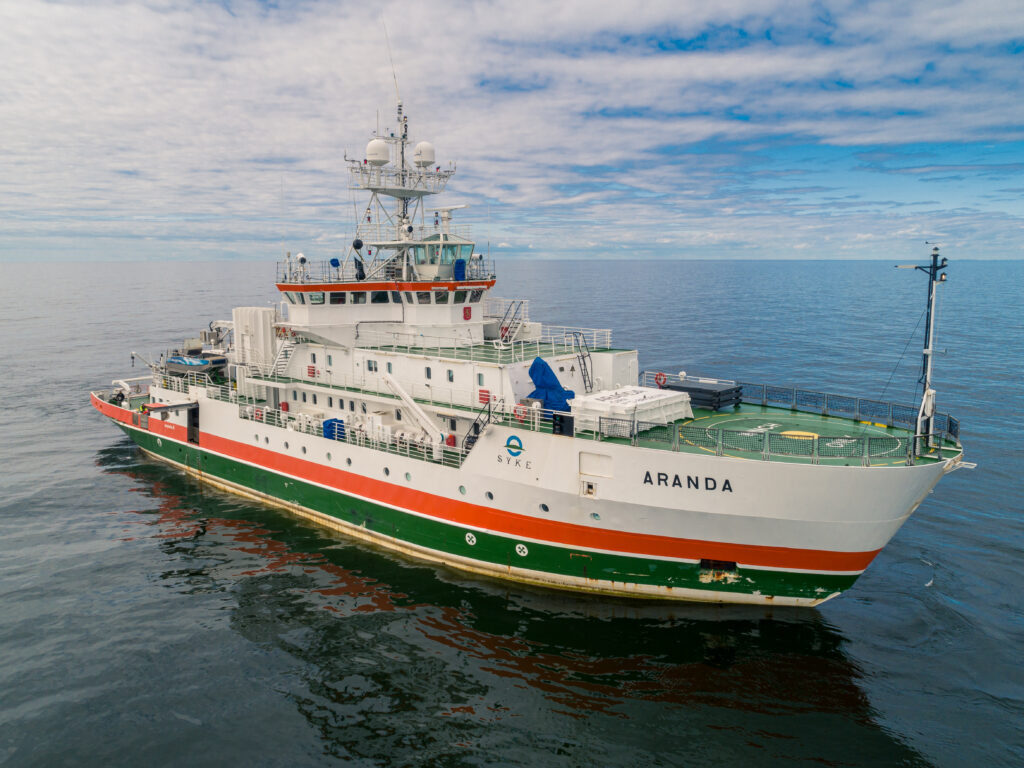
On June 15, the Finnish scientific ship “Aranda” will arrive in Liepaja, which is a full-fledged floating laboratory with a wide arsenal of data collection and sampling instruments and makes a significant contribution to the observation and monitoring of seas and oceans.
The Finnish Environmental Institute’s marine research vessel “Aranda” with its team of scientists will moor in the Trade Canal opposite the Customs House, Vecaja ostmala 54, to introduce visitors to sea and ocean research and the Baltic Sea environment. The daily life of the ship is quite busy, making regular research voyages in the Baltic Sea, thus serving as an important platform for marine exploration.
In Liepaja, the 66-meter-long ship “Aranda” will be opened:
In the tent city set up opposite the Customs house, from 9:00 a.m. to 6:00 p.m. there will be an opportunity for everyone intereseted to participate in various thematic workshops and educational activities together with Institute of Hydroecology of Latvia, the University of Liepaja and the Liepaja Municipal Education department Science and Education Innovation Centre (ZIIC) specialists.
Built in 1989 and rebuilt in 2018, Aranda is a modern ice-class research vessel designed and built specifically for research in the Baltic Sea, but is also capable of operating in the Arctic and Antarctic seas. A team of almost 30 scientists works daily in Aranda’s specially equipped, 270 square meter laboratories. The ship’s kitchen, cabins and even a scientific library allow it to go on research voyages of up to two months. In the world, the use of specially equipped ships in research has already started in the second half of the 18th century. Modern research vessels are designed to serve as full-fledged research support platforms, given the demand for science-based information, the rapid development of technology and the growing need for new ocean observations.
The visit of the scientific ship "Aranda" to Liepaja is organized by the Finnish Environmental Institute SYKE in cooperation with the Finnish Embassy in Latvia, the Liepaja City Municipality Administration, the Liepaja City Education Board, the University of Liepaja and the Latvian Institute of Hydroecology within the framework of the BALTICITIES international project. Liepaja Municipal Education department Science and Education Innovation Centre (ZIIC) equipment used in the implementation of the activities has been purchased within the project "Development of the Innovation Centre in Liepaja City" that is funded by the EEA/N grant programme "Research and Education". Its total cost is EUR 986 049.00, of which EUR 754 327.40 is co-financing of the Norwegian Financial Instrument, EUR 133 116.60 is co-financed by the S
21. November, 2023
From August 16 to 19, the Science and Education Innovation Center of Liepaja Municipal Education Department, Pēteris Lapiņš, an expert…


